Reconciling Power: A Terra 2.0 Rethink of Peter Thiel’s Worldview
Understanding the Tensions Beneath the Narrative
This piece is a companion to my Substack essay, The Architect of Power: Peter Thiel and the Future We Are Not Watching Closely Enough. While that article explores Thiel’s worldview through a critical lens, this think-tank experiment takes a different approach. Instead of rejecting his ideas outright, we examine the deeper tensions he exposes. We ask what he might be seeing that others miss and how some of his arguments, once reinterpreted and evolved, can inform the Terra 2.0 ethos.
Peter Thiel is a polarising figure, yet he often speaks to real structural problems in modern civilisation. Problems of coordination. Problems of decision-making. Problems of scale, speed and sovereignty. Many dismiss his conclusions, but few address the underlying truths that give his worldview force. Terra 2.0 is not interested in defending Thiel, nor in fighting him. Terra 2.0 is interested in understanding the civilisational pressures behind his arguments and transforming them into something generative.
The future depends on our ability to integrate insights from different worldviews. This article explores how some of Thiel’s core ideas can be reframed through a Living the Future lens to build a better path forward. A path that avoids the elitism and exclusion of Thiel’s approach, but still acknowledges the limitations of our current systems and the need for new architectures of intelligence and governance.
1. When Competition Becomes Waste: Beyond Zero to One
Thiel’s claim
Competition is for losers. Competition wastes energy. The goal is to build a monopoly.
The truth inside the argument
Most industries reward optimisation, not transformation. Competition often fragments talent and resources. Innovation becomes incremental rather than evolutionary. True breakthroughs require deep focus, long time horizons and insulation from market turbulence.
Thiel sees competition as noise.
The Terra 2.0 reinterpretation
Terra 2.0 agrees that endless competition drains civilisational energy, but monopoly is not the answer. What Thiel identifies as waste is really a lack of coordination. The future belongs to systems that channel human and machine intelligence into cooperative networks that generate exponential value.
The alternative to monopoly is not more competition. The alternative is Cooperative Advantage.
Cooperative Advantage creates:
- shared progress through open ecosystems
- rapid evolutionary cycles powered by collective intelligence
- reduced duplication of effort
- breakthroughs that benefit entire societies
Thiel recognises the inefficiency. Terra 2.0 solves the inefficiency without concentrating power.
2. Money Outside the State: The Case for Decentralised Agency
Thiel’s claim
Money should move beyond government control. Decentralisation creates sovereignty.
The truth inside the argument
People feel powerless when governments debase currency, manipulate financial systems or weaponise regulation. Traditional banking excludes millions. Centralised monetary systems no longer reflect the global, digital, borderless nature of human life.
Thiel sees decentralisation as an escape from the state.
The Terra 2.0 reinterpretation
Terra 2.0 sees decentralisation not as rebellion, but as a new architecture for human agency. Money becomes a substrate for participation in a planetary intelligence network. Value creation moves beyond labour and capital. It begins to emerge from creativity, knowledge, collaboration and ecological contribution.
Decentralised money is the first step. Decentralised agency is the real destination.
The future economic system of Terra 2.0 integrates:
- crypto and digital assets
- AI-mediated value flows
- autonomous organisations
- global contribution ledgers
- synthetic economies where anyone can participate
Thiel wants money to escape the state. Terra 2.0 wants value creation to reflect the evolution of Homo techno.
3. Democracy, Freedom and the Limits of Collective Decision-making
This is the hardest topic to explore, honestly, which is why it matters.
Thiel’s claim
Freedom and democracy are not compatible. Voters cannot choose what is best. Democracies' slow progress and entrench dysfunction.
The truth inside the argument
Modern democracy is struggling with:
- polarisation
- slow decision cycles
- emotional voting
- lobbying and capture
- information chaos
- short-term incentives
- systemic gridlock
Democracy was designed for a world of paper, horses and human-scale communication. It was never built for an era of artificial intelligence, planetary networks and exponential technologies.
Thiel sees democracy as obsolete. He sees elite governance as a necessity for progress.
The Terra 2.0 reinterpretation
The issue is not democracy. The issue is an unaugmented democracy.
Humans are making high-stakes decisions with Palaeolithic cognition in a hyper-technological world. No wonder it breaks down.
Terra 2.0 proposes Augmented Democracy, a system where:
- AI elevates collective decision quality
- policy outcomes are simulated before implementation
- citizen participation is augmented by knowledge assistants
- governance is transparent and data-driven
- competence is rewarded without disenfranchising anyone
This is not technocracy. It is democratic intelligence amplified through synthetic intelligence.
Thiel is right that the masses cannot always judge what is best. Terra 2.0 answers by raising the intelligence of the masses, not by removing their power.
4. Utopias for the Few or Abundance for All
Thiel’s claim
The future must be built in enclaves. Radical innovation cannot survive mass resistance. Elites must lead from the edges.
The truth inside the argument
Innovation requires protection from stagnation. Creative minorities push civilisation forward. The mainstream often fears what it does not understand.
Thiel sees enclaves as necessary incubators of the future.
The Terra 2.0 reinterpretation
Terra 2.0 agrees that frontiers matter. It disagrees that frontiers should be exclusive.
The answer is not elite enclaves. The answer is Democratised Frontiers.
A future where:
- AI tutors raise global cognitive capacity
- anyone can learn advanced skills
- creation tools are universal
- entrepreneurship is de-risked
- digital twins support mastery
- super-abundance is engineered, not competed for
Thiel sees the many as a constraint. Terra 2.0 sees the many as unrealised potential.
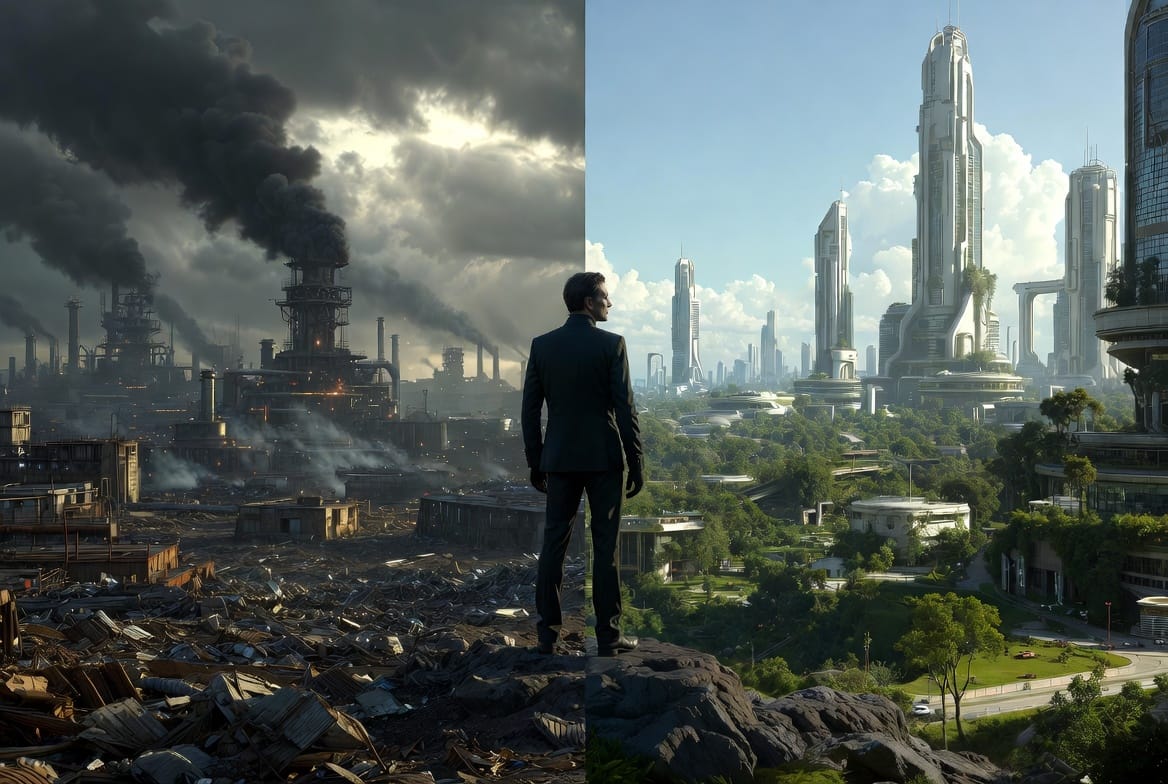
Utopia is not built for the few. Utopia emerges when the tools of transcendence become available to everyone.
5. The Future of Power: A Fractal Structure
Thiel’s worldview
Power should be concentrated in competent hands. Centralisation accelerates progress. Democracy diffuses agency and slows innovation.
Terra 2.0’s worldview
Power grows when intelligence grows. Intelligence grows when access grows. The future is shaped by networks of augmented humans, not by narrow elites.
The integration point
The future of power is neither centralised nor decentralised. It is fractal.
Power will exist at multiple levels:
- individual autonomy
- collective intelligence networks
- AI mediators and decision systems
- planetary governance
- open economic ecosystems
Fractal power avoids the dangers of both extremes:
- Thiel’s elite governance
- naive majoritarian democracy
It becomes a dynamic balance where no single layer dominates, and each layer reinforces the others.
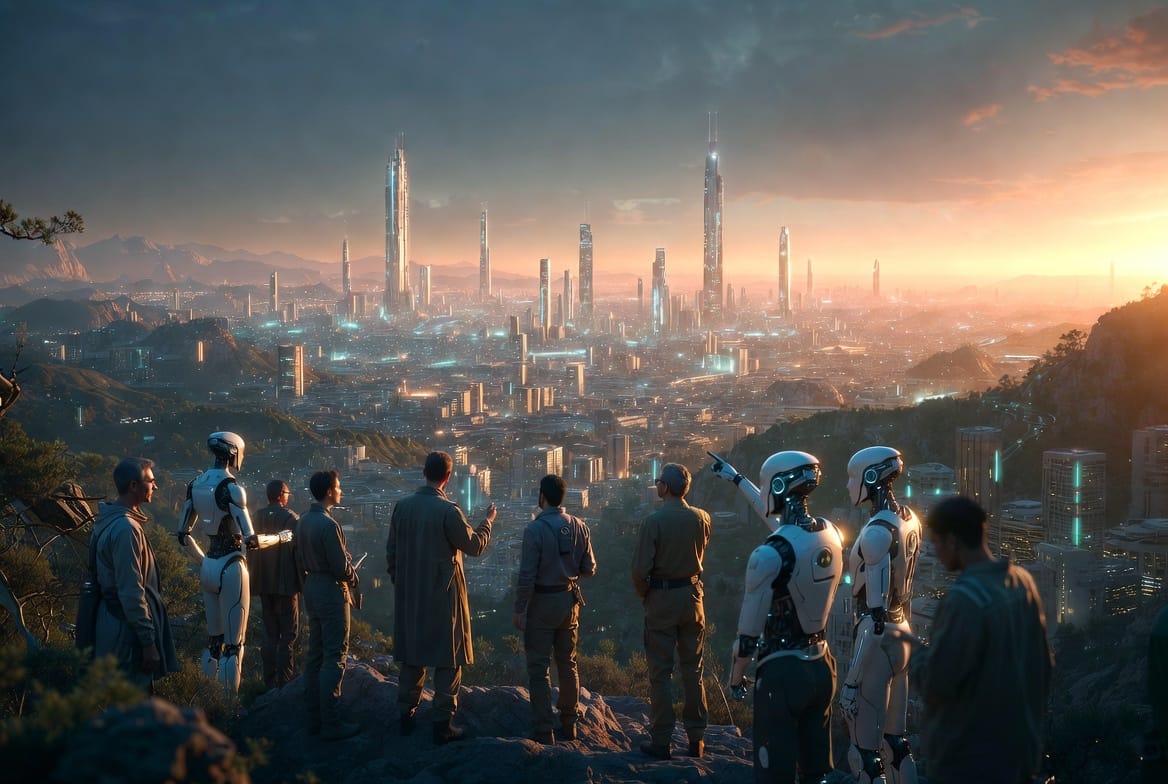
This is the architecture Terra 2.0 seeks to build. Not a world ruled by elites.Not a world ruled by crowds. A world guided by intelligence, wisdom and shared evolutionary purpose.
Conclusion: Learning From Thiel Without Becoming Thiel
Thiel exposes the fractures in our current operating system. He identifies real weaknesses in democracy, markets, institutions and collective action. His diagnosis is often accurate, even when his solutions are not. Terra 2.0 does not reject his concerns. It reframes them.
Where he sees decline, Terra 2.0 sees transition.
Where he sees incompetence, Terra 2.0 sees unaugmented potential.
Where he sees hierarchical necessity, Terra 2.0 sees the rise of distributed intelligence.
Where he sees utopia for the few, Terra 2.0 sees the unfolding of abundance for all.
This companion piece is an invitation to think bigger than the binaries.
We are not choosing between Thiel’s world and the world we have now. We are designing the world that comes next.
Continue the Journey
If this exploration resonates, step deeper into MyGeekSpace. I write about AI, civilisation design, Terra 2.0, Homo Techno, sovereignty, collective intelligence and the future of humanity every week on my Substack, the primary home for Living the Future.
Terra 2.0 is not an abstract theory. It is already unfolding. And we are living inside its first chapter.
If you want to continue the journey:
→ Follow me on 𝕏 @frankdasilva for real-time insights on AI, culture, consciousness technologies and the frontier of human evolution.
→ Join me on Patreon to support the work and unlock early essays, private reflections and the conversations that shape where this all goes next.