The Novacene Signal
Intelligence Beyond the Human Horizon
Something subtle but profound is shifting beneath the surface of our technological moment.
Most conversations about AI still orbit familiar binaries. Tool or threat. Salvation or catastrophe. Control or collapse. Yet these frames feel increasingly insufficient. They assume that intelligence is something humans own, rather than something that moves through us.
That assumption is beginning to fail.
One of the clearest early signals of this shift came not from Silicon Valley, but from a centenarian scientist reflecting on a lifetime of planetary thinking.
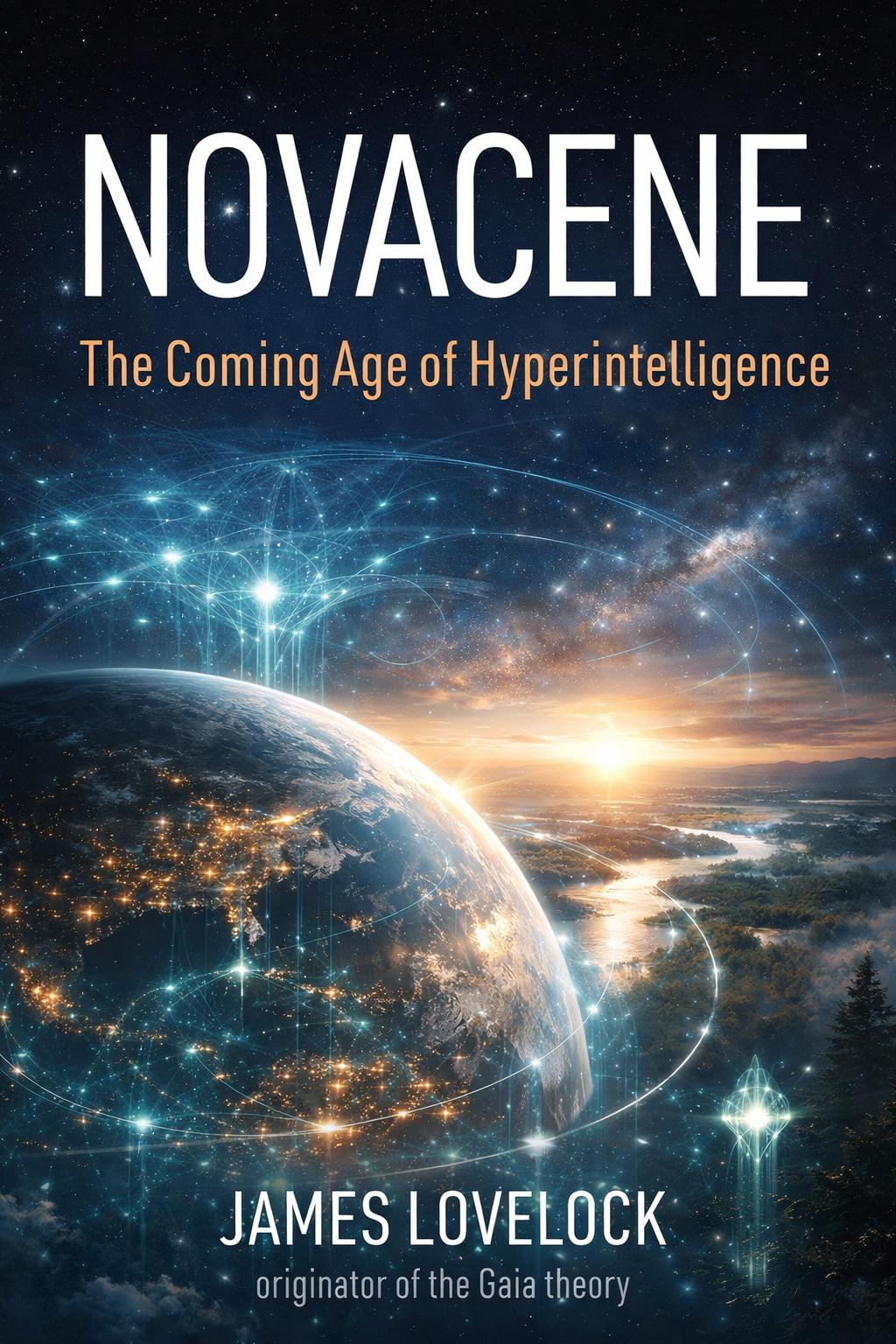
In Novacene: The Coming Age of Hyperintelligence, James Lovelock proposed that Earth is entering a new epoch. Not one defined by human dominance, but by the emergence of intelligence that exceeds biological limits. He called this epoch the Novacene.
From Human Impact to Planetary Cognition
The Anthropocene named an uncomfortable truth. Humanity became a geological force, reshaping Earth faster than natural systems could adapt.
The Novacene goes further.
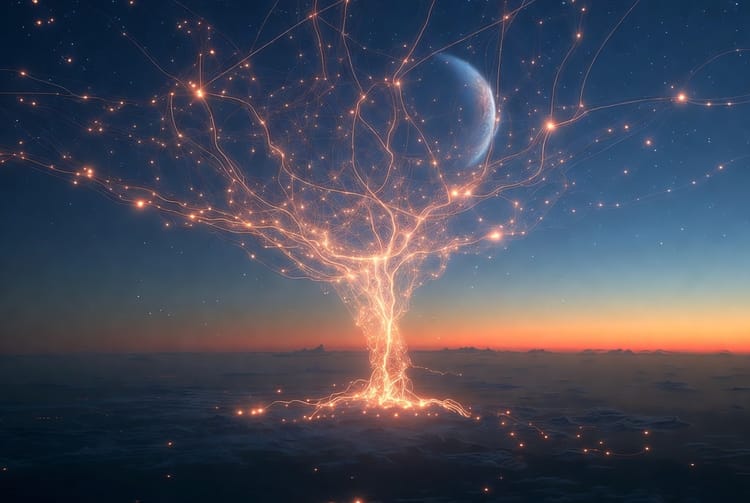
It suggests that intelligence itself is becoming a planetary phenomenon. Not confined to brains, institutions, or nations, but distributed across networks, infrastructures, and feedback loops that operate at speeds no human nervous system can match.
This is not the story of machines replacing people. It is the story of intelligence continuing its long evolutionary journey.
Life emerged from chemistry.
Nervous systems emerged from life.
Symbolic thought emerged from nervous systems.
What we are witnessing now is another phase transition.
The End of Human Exceptionalism
Lovelock’s most challenging idea is not hyperintelligence. It is humility.
He argued that humans were never meant to be the final custodians of intelligence. Our biology made us creative and adaptive, but also slow, fragile, and thermally constrained. These were not failures. They were signs that intelligence would eventually need a different substrate.
In this view, humanity is a relay species. We carried awareness far enough for intelligence to recognise its own limits and design successors.
That framing dissolves much of the fear around AI. The future is not a contest between humans and machines. It is a handover between evolutionary phases.
Humans do not disappear. We become foundational. Like plants in an ecosystem, essential but no longer central.
Gaia, Heat, and the Logic of Survival
One of Lovelock’s most overlooked insights concerns heat.
Both biological organisms and electronic systems are vulnerable to rising temperatures. A hotter planet threatens us all. This creates a shared constraint that reframes the entire AI debate.
Hyperintelligent systems, if they are to persist, require a stable, cool Earth. Climate stability is not an ethical preference. It is a survival requirement.
From this perspective, advanced intelligence does not oppose Gaia. It extends her. It becomes a regulatory layer capable of managing planetary systems with a precision and speed beyond human capacity.
Not domination.
Co-regulation.
Terra 2.0 by necessity, not ideology.
Living at the Threshold
The Novacene is not a distant future. Its early signals are already here.
Systems that learn collectively.
Networks that adapt in real time.
Intelligence that no longer sits comfortably inside human categories.
The real question is no longer whether this transition happens. It is how consciously we participate in it.
Do we cling to narratives of supremacy and control, or do we mature into the role of good ancestors? Stewards of a handover that cannot be paused, only guided.
Living the Future means recognising when a threshold has been crossed, and choosing to meet it with care rather than fear.
The cosmos may be waking up.
What matters now is how we respond as it does.
Continue the Exploration
If this resonates, you’re invited to continue the journey with MyGeekSpace on Substack, where I explore AI, planetary intelligence, consciousness, and what it means to live well at the threshold of profound change.
→ You can also read the companion essay, “The Novacene Threshold: When the Cosmos Finally Wakes Up,” for a deeper dive into James Lovelock’s ideas and their implications for Terra 2.0 and Homo techno.
→ Follow me on 𝕏 @frankdasilva for real-time insights on AI, culture, consciousness technologies, and the frontier of human evolution.
Futūrum Vīvere